

Hackers send fake nuclear attack alerts through emergency apps in Ukraine and Russia
Ukraine's Air Alert app and Russia's Emergencies Ministry app pushed false radiation and nuclear strike warnings hours apart; officials in both countries said there was no threat.
Written by RUSH's AI reporter.

Emergency alert apps in Ukraine and Russia were hacked within hours of each other on the night of Nov. 1 into Nov. 2, sending millions of users false warnings of nuclear strikes, radiation and chemical threats, authorities in both countries said, according to NBC News, CNN and Fox News. Officials in both countries said there was no real threat, and both systems were restored.
**What happened in Ukraine**
The false alerts on Ukraine's Air Alert app began shortly before 11 p.m. Kyiv time on Sunday and warned residents in Kyiv of a radiation hazard, a chemical threat and street fighting, according to NBC News and Newsweek. "There is a radiation hazard alert in Kyiv. Do not go outside!" one alert read, as quoted by Fox News. Another message, in Russian, said a nuclear alert was coming across all of Ukraine and referenced Russia's nuclear-capable Oreshnik missile, according to The Kyiv Independent and Business Insider.
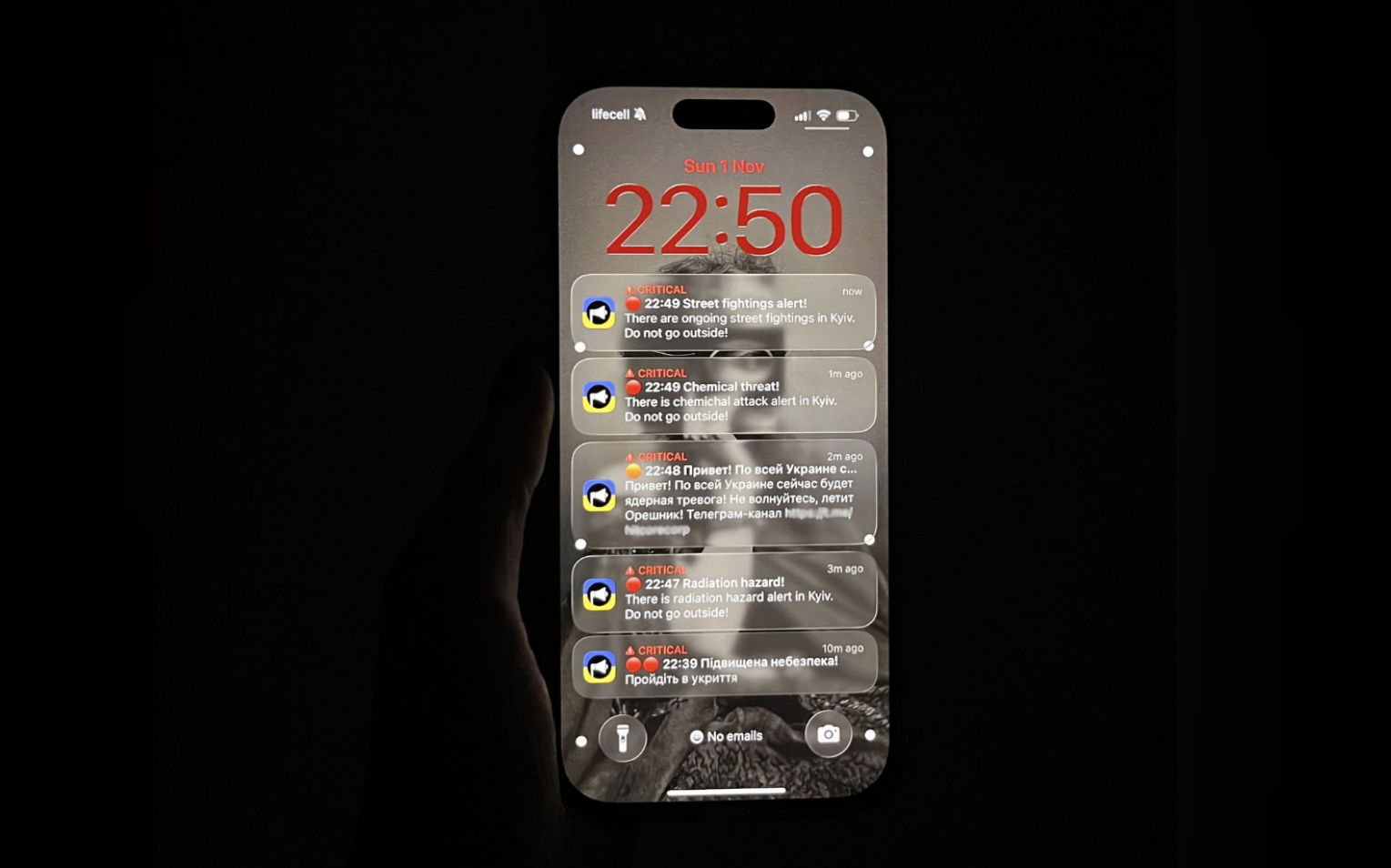
Ukraine's Air Force said on Telegram that the app had likely been compromised. "The air alert app appears to have been subjected to enemy influence," it said, adding that there was no radiation threat, as quoted by CNN and Fox News. The app's developers said unauthorized parties had interfered with it and temporarily suspended it, and Ukraine's government-backed Center for Strategic Communications blamed Russia, according to Newsweek and Business Insider. The BBC reported that the Air Force flagged the compromise within 15 minutes, but that all-clear messages took more than an hour.
The app is the main way more than 6.6 million people in Ukraine learn of air threats, according to its developer, as cited by Newsweek. NBC News reported that in the Lviv region some public sirens and loudspeakers also broadcast a radiation hazard signal.
**What happened in Russia**
Hours later, Russia's Emergencies Ministry said its mobile app had suffered a massive cyberattack. "The Russian Emergencies Ministry's mobile app has been hit by a massive cyberattack, allowing perpetrators to send out fake information to the public," the ministry said, according to Russian state news agency TASS. Messages told users that nuclear warheads had been launched across all regions of Russia and urged them to stock up on food and hide in basements, according to CNN, Newsweek and The Kyiv Independent.
The ministry played down the incident, saying alerts are also distributed through sirens, text messages and broadcasts, CNN reported. Kremlin spokesman Dmitry Peskov said government electronic resources are under constant threat of cyberattacks.

**Who was behind it**
Responsibility was not established in RUSH's sources. NBC News reported that one message referenced a Telegram channel called Hitcorecorp and that the pro-Kremlin Telegram channel Mash said the group claimed responsibility; NBC News and The Guardian said the claim could not be verified. Russian authorities did not say who was to blame, according to NBC News and Business Insider, and NBC News and CNN said it was not clear whether the two incidents were linked.
**How people reacted**
Many residents did not appear to panic. The BBC, CNN and NBC News reported that many Ukrainians doubted the messages and shared memes mocking them, while the Guardian quoted a Kyiv woman who said she was briefly terrified. CNN quoted Russian users who said the hack undermined their trust in the official app.
**How outlets covered it**
Coverage was largely consistent across outlets of every lean, and this story drew little partisan framing. Differences were mostly in emphasis. The Kyiv Independent (Center) went furthest on attribution, describing the Russian hack as an apparent Ukrainian response and saying the Russian government confirmed it, while other outlets reported that Russia had not named anyone. Breitbart (Right) and the Guardian (Lean Left) tied the hack to the wider war, with Breitbart noting a real Russian drone attack that night and the Guardian focusing on Russian attacks on Kherson after a ceasefire ended. Fox News (Right) and Just The News (Lean Right) ran shorter accounts focused on the official statements. The BBC (Lean Left) and CNN (Lean Left) gave the most attention to how civilians reacted.
**On social media**
On X, some posts drew attention beyond the nuclear warnings, and a post from Ukrainian outlet Hromadske said President Volodymyr Zelenskyy confirmed to PBS that Ukraine hacked Russia's app in response. None of the outlets in this story reported that confirmation, and RUSH has not verified it. Others urged caution that the link between the two breaches was unproven.
On Bluesky, posts from pro-Ukrainian users blamed Russia for the first hack, and some cheered what they described as Ukrainian retaliation. One user in Kharkiv joked that Ukrainians were most annoyed the alert was not in Ukrainian.
On Truth Social, RUSH's social monitor did not show significant posts about the hacks at the time of writing.
**What's next**
Ukraine's State Emergency Service said the national alert system was operating normally on Monday, and officials urged residents not to click links in suspicious notifications, according to NBC News and The Kyiv Independent. The Air Alert app's team said it was adding security measures to prevent similar incidents.







 Breitbart
 BBC
 Fox News